
Get a PDF of One of Our Emergency Medicine Pocketbooks for $15-$19 a piece
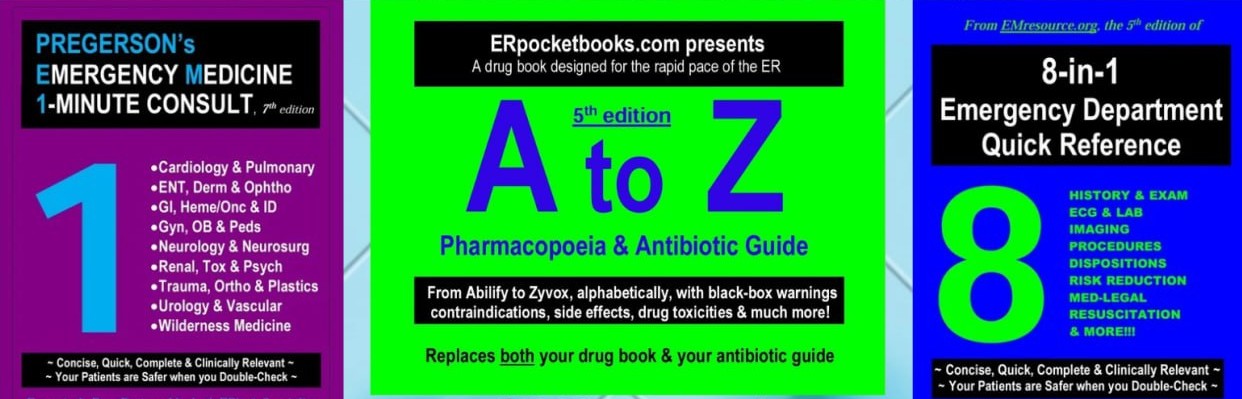
- A-to-Z EM Pocket Pharmacopoeia & Antibiotic Guide, 5th edition: Tabular, alphabetic and quick to use with side effects and contraindications for each drug. Also has a complete empiric antibiotic guide, procedural sedation and more
- Emergency Medicine 1-Minute Consult Pocketbook, 5th edition: Entries on every EM topic you can think of with chapters on topics from Allergies to Wilderness Medicine. Each entry includes clinical findings, testing, treatment and disposition
- 8-in-1 Emergency Department Quick Reference, 5th edition: Eight books in one. Chapters on H&P, History, EKG, Lab, Imaging, Procedures, Disposition, EM Guideline, Risk management, Lawsuits, Career, Wellness and more
Emergency Medicine Rules of the Road (click here for all 16)
-
- Read the triage note
- Patients/medics may have told triage nurse something important but forgot to or couldn’t tell you
- If there is an inconsistency between triage and your history make sure to clarify that
- History is king
- It is not the patient’s job to provide a good history; it is your job to elicit one
- Listen to your bedside nurse if they raise concerns and document your response
- Know when to dig deeper, like with timing and duration for chest pain
- If there is pain always have them show you exactly where by pointing.
- Always think worst case scenario first
- This is also in the original 10 commandments: LINK or see summary below
- Reasonably rule out the more rare but more dangerous explanation before landing on the benign one.
- Remember: you are a detective not a gambler and ER patients are guilty until proven innocent
- Read the triage note
EMresouce.org is an online resource for Emergency Medicine Providers
- Look it up: our Resource pages boast a documentation macro library, a list of practice-changing literature, & more
- Test you skill: check out our library of EM Case Challenges. You can subscribe to receive them weekly
- Get visual: Browse our EM Ultrasound Library: Cardiac, Aorta, OB/Gyn and much more.
- Fill your pocket: Visit our Book Store for pocket reference texts & cards, CD’s, PDF texts and more
****
TESTIMONIALS & QUOTATIONS
“Dr. Pregerson. You have no idea how many times you rescued me over the years with your exceptional handbooks. I put you in the ranks of the great ones (Like Tintinalli, Rosen, Greg Henry, etc. I love your handbooks and recommend them often to young doctors whom I mentor.” – Gordy Leingang, DO, FACEP, FACOEP. Bismarck, ND.
“It’s not our patient’s job to prove they are sick. It’s our job to prove they are not.” – Yaron Ivan, MD
https://erpocketbooks.com/wp-admin/